The Kuleana Way: Surfing as Indigenous Hawaiian Resistance
How Indigenous Traditions in the Hawaiian Surfing Community Challenge the Modern Notion of the Nation State

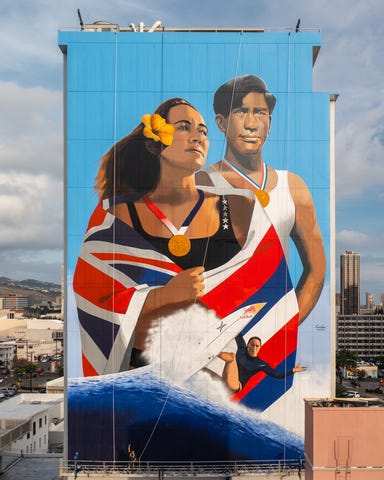
This paper focuses on indigenous Hawaiian surfing culture and the way in which it complicates commonly-held notions of the nation state, borders, and national identity. It examines these ideas in four main sections. The first section, Modern Hawaiian Surf Culture and the Olympics, delves into anthropological literature on the unique complexities of Hawaiian identity and the impacts of the 2020 Olympics on Hawaiian surfing culture. The second section, Historical Perspectives, focuses on the historical literature of surfing (specifically regarding the Hui Nalu Club and the Waikīkī Beach Boys). The third section, The Surf Zone as a Place of Resistance, works through the surf zone and Hawaiian kuleana (responsibility) as a means of resistance. Part four, Sovereignty, Borders, and Hawaiian Surfing’s Alternative Imaginings, explores how the indigenous Hawaiian surfing identity has fostered an anti-colonial mindset which provides a foundation upon which to build alternative imaginings concerning national identity and border ideologies.
Surfing is deeply connected to indigenous Hawaiian culture. Indeed, it is one of the few aspects of the culture that has survived, and even thrived, into the twenty-first century. The recent introduction of surfing into the Olympic Games has brought surfing to the attention of the wider world. Thus, it is imperative that we are reminded of the sacred traditions of the sport, it’s modern day internal conflicts, and the lessons it can teach us going forward about sovereignty and the potential identities of a body politic. With that in mind, I’ve chosen to ask the following questions about surfing culture in Hawaiʻi: How do indigenous traditions in the Hawaiian surfing community challenge the modern notion of the nation state; and how can these local values impact the global dialogue on borders and national identity? My research yielded the following conclusion: Hawaiian surfing identity works in tandem with the surf zone to combat colonial hegemony by providing a blueprint for creating alternative imaginings which challenge the status quo logic of borders and acceptable forms of national identity.
I was first inspired to research the roots of surfing culture and the impact indigenous Hawaiians continue to have in the niche world of global surfing when reading Barbarian Days, a vivid autobiography by William Finnegan. New places, border crossings, fresh smells and tastes; these were all things that Finnegan wrote about cherishing and perpetually seeking out. He did all this in the name of chasing the perfect wave to surf. This wave only existed in a dream, a world away from reality, yet seemingly always right around the next sandbank, in the next inlet, or across the next channel between distant Polynesian islands. In his book, Finnegan reflects on his adventures as follows:
The particulars of new places grabbed me and held me, the sweep of new coasts, cold, lovely, dawns. The world was incomprehensibly large, and there was still so much to see. Yes, I got sick sometimes of being an expatriate, always ignorant, on the outside of things, but I didn't feel ready for domestic life, for seeing the same people, the same places, thinking more or less the same thoughts, each day. I liked surrendering to the onrush, the uncertainty, the serendipity of the road.
This quote sheds light on the mindset of a surfer and the borderless nature of a sport which literally follows the tides. Finnegan was deeply influenced by Hawaiian surf culture, having spent some of his childhood navigating the islands’ best breaks, but he was also haole (a non-native Hawaiian, usually a white person). I had to dig a little deeper to understand the perspective of a contemporary indigenous Hawaiian surfer. Luckily, one of the surfers selected to represent the United States at the 2020 Summer Olympics in Japan, the mighty Carissa Moore, is one of the most high profile indigenous Hawaiians alive today.
Part 1: Modern Hawaiian Surf Culture and the Olympics
In 2020 surfing graced the world stage at the Olympics for the first time. This event had been long in the making, dating back over a century. In the early twentieth century, the legendary Duke Kahanamoku, considered by many to be the father of modern surfing, wrote in his biography that “even as early as… (1918), I was already thinking of how [surfing] could someday become one of the events in the Olympic Games. Why not?” Accordingly, the inclusion of surfing in the Olympic Games in 2020 offers us a portal through which to view the deep-rooted history of surfing in Hawaiʻi, as well as contemplate the future of the sport as it expands in demand and popularity. However, when discussing the sport of surfing at the Olympics there is one glaring problem: Hawaiian athletes cannot compete for Hawaiʻi.
It might seem intuitive that Hawaiian athletes represent the United States of America, of which Hawaiʻi counts itself a member, but in the world of surfing the truth is a little more complicated. The World Surf League (WSL), and the surfing community more broadly, consider Hawaiian identity and Hawaiian surfers separate from their mainland U.S. counterparts. In the world of surfing you either represent the U.S. or Hawaiʻi, never both. This is why not being able to compete under the Hawaiian flag at the Tokyo Olympics struck a chord in the close-knit community on the islands of Hawaiʻi, the birthplace of surfing. This brings us back to Carrisa Moore. She is a native Hawaiian, world champion surfer and activist, as well as the first ever female Olympic gold medalist in surfing. As the most prominent native Hawaiian surfer, she carries an immense responsibility. She represents her culture in international competition, and despite representing the United States at the 2020 Olympics, when she wins she wins for Hawaiʻi. Moore has been vocal about this political dynamic, eloquently educating the public on her own allegiances:
I think my relationship with surfing is different because I am a Native Hawaiian. I surf because I love it. I don’t do it for the money, for the fame or accolades. That stuff is great, but I do it because it fills up my soul and that is why my ancestors did it. I feel most at home and at peace with myself in the ocean. I don’t think, I just let it flow from my na‘au [gut, heart]. I feel especially connected to the ocean when I am at home in Hawaiʻi.
It comes as no surprise that native Hawaiian surfers represent more than their competitors. They symbolically bear the weight of the lāhui (people/nation) and Hawaiian culture on their shoulders.
A closer look at the American Olympic surf team might confuse the average person, unaccustomed to the political undertones of Hawaiian surf culture. Two of the four team members on the American surf team were born in Hawaiʻi and have competed under its flag for their entire lives. However, there is a slight, but crucially important, difference between the two Hawaiian competitors. The other Hawaiian, another WSL world champion named John John Florence, was born in Hawaiʻi but is not indigenous Hawaiian. His family’s bloodline does not date back to before colonization on the Hawaiian islands. That is not to say that Florence is comfortable flying the American flag. “There’s a little bit of tension with that, going into the Olympics under a U.S.A. flag,” Florence explained. “I don’t want to divide at all. I’m not anti-anything. I’m pro-Hawaiʻi.” Despite his personal Hawaiian connections, he does not experience the added pressure hoisted upon indigenous Hawaiian surfing athletes.
There are deeply ingrained complications between haole and indigenous Hawaiians that date back around 150 years in the world of surfing. To indigenous Hawaiians, surfing is seen as one of the most sacred aspects of their culture, and a practice which symbolizes the fight for local traditions and against American colonialism. As one prominent native Hawaiian described, surfing “has prevailed against the possible suppression into oblivion.” He went on, remarking that surfing “endured the challenge of being exterminated at one time. And now it needs to be a source of Hawaiian pride.” This source of pride is not only recognized on the Hawaiian islands, it is commonly accepted by surfers the world over that surfing in Hawaiʻi is different from surfing anywhere else, if only for the fact that it was originally created on the islands. Keaulana, the grandson of Duke Kahanamoku, the forefather of modern surfing mentioned earlier, expands on this concept further, stating that “in surfing culture worldwide, everybody looks at Hawaiian surfing as different. Even California surfers look at Hawaiʻi different.” But unfortunately, and contrary to the edicts of global surfing politics, the “Olympics see us as the same.” This contradiction between the surfers and the wider sporting community, brought into harsh reality at the Olympics, discounts the traditions of surfing and erases the history of the culture without which the sport would not even exist in the first place. The Olympics have made exceptions to territories and other non-state entities to compete in the Olympics before (see Puerto Rico), but it refused to allow Hawaiians to compete under their own flag in the competition. This exemplifies a larger trend in surfing, as its athletes are yet to receive the respect and competitive achievements (both culturally and monetarily) in the larger sporting world.
Part 2: Historical Perspectives
This lack of respect has been slowly changing in recent decades, but it dates back to over a century ago when Americans first colonized the Hawaiian islands. The earliest recorded instance of surfing dates back to the mid-1700s, but it is possible the practice goes back even further. Native Hawaiians call surfing he’e nalu, and define it as a dynamic relationship with the sea on a social and spiritual level. This communal exchange with the ocean can be seen in other Pacific Island cultures' resistance to colonization and dominant hegemonic narratives. To native Hawaiians surfing allowed for spirituality and connection to the far reaches of the ocean and its vast wisdom. This relates to the work of Epeli Hau’ofa, who argued that instead of land-locked borders—which results in peoples’ isolation and the restriction of free movement—the Pacific ocean has actually served as a connecting link between different islands and their people. In this light, surfing can serve as a lens to Hawaiian pre-colonial history and indigenous experiences. In his article entitled “Hui Nalu, Beachboys, and the Surfing Border-lands of Hawai’i,” Isaiah Helekunihi Walker states that “for many Native Hawaiians, the ocean surf has been a window for looking into their precolonial Hawaiian past, and a place where contemporary identities have developed in relation to both the past and present.” In a way, Hawaiian identities morphed during colonization in opposition to the newcomers. This transformation was developed in the water, away from the colonial conquest taking place on the island's shores and land.
The importance of surfing in ancient Hawaiian society can be seen in the many traditional stories where the chieftains and other heroes surf and are cast as strong and clever leaders in their communities. The telling of these stories was stifled when Hawaii was annexed to the United States on August 12 of 1898. For many native Hawaiians, surfing served as a form of solace and escape from the lived reality of political injustices, racial discrimination, and exploitation that came with the American colonial presence. Surfing's popularity rose in Honolulu at the turn of the century among natives. Seeking to tap into this organic excitement, Alexander Hume Ford, a former Chicago newscaster, arrived in Honolulu in 1907. He immediately took an interest in surfing and other traditional aquatic activities. In 1908 he founded the Outrigger Canoe Club, a surfing and aquatics club that exclusively catered to his fellow haole. The whites only club grew rapidly and soon came to boast local politicians, business leaders, and many wealthy patrons among its members (which came to total around twelve hundred). Even some leading annexationists in support of the colonial project like Lorrin Thurston and J.P. Cooke rose to leadership positions within the club. However, the indigenous Hawaiians would not be pushed aside so easily in the waters they had called home for centuries.
The Hui Nalu Club in Waikiki was the first significant organization of colonial resistance. The club, which focused on surfing as its main activity, came into existence to counter the colonial project of the Outrigger Canoe Club. It was founded under a tree in Waikiki in 1911 and was composed of native Hawaiians and part-Hawaiians. The members of the club would get into fights with the Outrigger club members and occasionally put on competitions. These competitions served as a place for “a certain ethnic pride” to be exhibited as “haole vied with Hawaiians in ancient water sports which were considered to be the domain of the latter.” In the end, the Hawaiian surfers came out on top, and through this exercise regained some piece of their dominant place on the beaches of the islands. Hui Nalu surfers like John Kaupiko and Duke Kahanamoku came to control not just the line-up in the water but also wielded significant social power on land as well, using their influence to push back against the official state messaging that the Hawaiian natives were deferential and submissive new American subjects.
One of the most famous surf groups of all time was born out of the Hui Nalu club: the Waikīkī Beach Boys. The group grew out of the traditions of the Hui Nalu club and sold tours, surfing lessons, concessions, etc. on the beach to tourists and rich benefactors. The members of the group, almost exclusively men, “were known for wooing various types of women—divorced women, wealthy women, showgirls, and daughters of wealthy visitors.” They wore fancy outfits and possessed suave personalities, social influence, and power over women and cultural areas typically reserved for wealthy white elites. As Walker recounts, “in many ways, sexual encounters with white women in the surf became an identity marker for these men, as it meant they too could participate in engendered conquests.” These encounters literally took place in the surf on many occasions, as the indigenous surf teachers got up close and personal on tandem surfboards, as a way to impress women and woo them into encounters later in the night. The Beach Boys refused to fit into the prescribed social roles hoisted upon them by haole colonizing elites. This resistance to the colonial objectives of the Americans was made possible by surfing and the fact that Hawaiians controlled the ocean and knew the tides better than their haole counterparts. In this way, the Waikīkī Beach Boys were able to become independent political agents in the struggle against colonial occupation and the prescribed social norms.
Part 3: The Surf Zone as a Place of Resistance
To Kānaka Maoli (native Hawaiians) the Ka po’ina nalu, which refers to the surf zone, “constitutes a Hawaiian realm, a space overlooked by outsiders that was and is extremely significant.” The surf zone created a place to resist colonization in many forms: allowing native Hawaiians the freedom to express themselves in traditional manner, to secure positions on the top of social hierarchies, thwart colonial progression and the erosion of native culture, and flip prevailing power structures upside down. The Waikīkī Beach Boys of the early 1900s are the best example of this, but the practice continues to this day. In the surf zone white hegemony is uncertain as native Hawaiians invert the expected social standards of the colonized islands. By using surfing to violate the “colonial expectations of how Hawaiian men should behave,” native Hawaiians were able to accomplish “all that they were expected not to” in the beginning of the twentieth century. Some examples of this resistance included fighting against haole annexationists, courting white women, making large sums of money through beach touring and concession businesses, fighting American and European soldiers, creating and policing the rules of the water at Waikīkī and beyond, as well as expressing their cultural autonomy and traditional Hawaiian identity.
This resistance is not viewed as a conscious choice among many native Hawaiians, but rather as a responsibility passed down from their ancestors. This responsibility is termed kuleana in native parlance. As Walker explains, “since Native Hawaiians often link he’e nalu (surfing) to their mo’okū’auhau (genealogy) from their kupuna (ancestors and elders), their identities are imbued with additional significance and kuleana.” With this responsibility in mind, maintaining a sense of identity and Hawaiian control in the surf is fundamental in a proxy battle between those who advocate for indigenous political sovereignty and American colonists. The fight for political independence in Hawai’i has been long and hard fought, and remains a prominent part of native political thought to this day. There are two approaches to resisting what some see as American occupation. The first approach, illustrated by the Akaka Bill which stalled in congress, would result in the federal recognition of native Hawaiians—similar to how Native Americans are recognized on the mainland—falls under the category of native recognition. The second approach, de-occupation, inspired by political scientist Keanu Sai, calls for the cessation of American occupation of the Hawaiian islands. The people who fight these political battles draw on the skill of Hawaiian surfers and the power of the waves to tap into the culture of their ancestors and popularize the anti-colonial cause.
Political resistance in the surf zone has in many instances been indicative of Hawaiian control over surfing lineups, especially the most coveted surf spots on the islands. This has only come with hard work and political organizing. Many community organizations on the ground have worked tirelessly to preserve native access to surfing spots and entrance to competitions. In addition, they have also organized community-wide projects to maintain and care for both the ocean and the land. The symbolic imagery of Hawaiian nationalism at the International Surfing Association (ISA) World Championships serves as an example of the power of surfing to inspire political resistance. When Hawaii won the competition, beating out countries like the United States and Australia, the national anthem of Hawai’i was played over loudspeakers. The song, Hawaiʻi Ponoʻī, written by King David Kalākaua in 1876, shows respect and pride for the late Kingdom of Hawaiʻi. To many indigenous Hawaiians, the significance of hearing this song serves as a celebration of more than simply winning a competition: it connotes the continued survival of native Hawaiian culture and the possibility of independence and political sovereignty in the future.
Part 4: Sovereignty, Borders, and Hawaiian Surfing’s Alternative Imaginings
As previously recounted, alternative imaginings regarding Hawaiian political existence are embedded into the very fabric of surf culture. This is consciously promoted by indigenous leaders on the Hawaiian islands, but it is also unconsciously supported by the hundreds of thousands of surfers around the world who revere and respect Hawaiian sovereignty in the waves. This fact cannot be taken for granted; in fact, it is extremely rare to find this respect for native sovereignty in arguments around national identity. Hawaiian surfing sovereignty is a grassroots movement which has been able to remain relatively successful (despite the Olympics) because it takes place in a sport which has traditionally been seen as falling outside the domain of capitalistic marketability dominated by conventional sports. This may change as surfing continues to develop in an increasingly globalized world. However, we cannot forget the lessons that Hawaiian surfing culture teaches us and the hope it provides. The fact that the surf zone remained a completely autonomous Hawaiian realm, where indigenous identity could be safely expressed and even thrive, demonstrates a successful approach to resisting dominant top-down political power.
Throughout the nineteenth and twentieth centuries the surf zone remained uniquely Hawaiian, showing the inability of borders—which are in essence arbitrary lines drawn by politicians—to direct the political and cultural choices of a body politic. In this way, surfing, working in tandem with indigenous Hawaiian culture, complicates ideas of national identity. The surf zone and its ideas reject commonly accepted dogmas on borders and their rationales. Just because Hawai’i technically resides within the borders of the United States, many indigenous Hawaiians do not feel allegiance to the American flag. Surfing acts as a lens to Hawaiian pre-colonial past and indigenous histories while providing a blueprint for rethinking national identity and border ideologies in an emerging global world. As Jon Anderson writes, the geographical imagination is “oriented towards issues of social, economic, and spatial power: how identities are formed, orders given, and borders controlled” Hawaiian surf culture makes space for alternative border understandings to form while simultaneously promoting discounted native identities. This brings us back to my original inspiration: William Finnegan. He has surfed at spots the world over and been inspired to do away with borders in his search for the perfect wave. Yet, even to Finnegan, Hawaiian waves stand in such high esteem as to be almost spiritual, a reason for his journeys. He wrote that when he surfed Honolua Bay, one of the most famous Hawaiian surf spots, “the wave commanded such devotion that I could see renouncing all other ambition than to surf it, every time it broke, forever.” Even to the mind of an international surfing romantic, Hawai’i will always be ground zero.
Sources
Booth, Douglas. "15. The Political Economy of Surfing Culture: Production, Profit, and Representation" In The Critical Surf Studies Reader edited by Dexter Zavalza Hough-Snee and Alexander Sotelo Eastman, 318-341. New York, USA: Duke University Press, 2017.
Branch, John. “'I'm Not Anti-Anything. I'm Pro-Hawaii.'.” The New York Times, The New York Times, 17 May 2021.
Doering, A. (2018). From he’e nalu to Olympic sport: A century of surfing evolution. In T. Hinch & J. Higham, Sport Tourism Development (3 rd ed.), pp. 200-203. Bristol: Channel View Publications.
Finnegan, William. 2016. Barbarian Days: A Surfing Life. London: Penguin Publishing Group.
Hau’ofa, Epeli. “Our Sea of Islands.” The Contemporary Pacific 6, no. 1 (1994): 148–61.
Ingersoll, Karin E. Waves of Knowing : a Seascape Epistemology. Durham: Duke University Press, 2016.
Walker, Isaiah Helekunihi. “Kai Ea: Rising Waves of National and Ethnic Hawaiian Identities.” In The Critical Surf Studies Reader, edited by Dexter Zavalza Hough-Snee and Alexander Sotelo Eastman, 62–83. Duke University Press, 2017.
Walker, Isaiah Helekunihi. “Hui Nalu, Beachboys, and the Surfing Boarder-Lands of Hawai’i.” The Contemporary Pacific 20, no. 1 (2008): 89–113.